In Massachusetts, most homeowners policies cover sudden and accidental water damage from a burst pipe, including damage to walls, floors, ceilings and your belongings. They usually do not pay to fix the failed pipe itself, and they often exclude slow leaks, flooding from outside, sewer backup without an endorsement, and freezing in a home that was left unheated. Stop the water, document everything, report the claim promptly, and start drying. Need that done now? Call (413) 603-1274.
What is usually covered
- Water damage to the structure from a sudden burst: drywall, plaster, ceilings, floors, cabinets
- Tearing out and putting back walls or floors to reach the broken pipe
- Water extraction, drying and cleanup
- Your damaged belongings, under personal property coverage
- Extra living costs if the home cannot be lived in during repairs
Each policy is different. Your declarations page and the water and freezing sections of your policy decide what applies. This page is general information, not legal or insurance advice.
What is often not covered
| Situation | Usual result | Read more |
|---|---|---|
| Repairing the pipe itself | Often treated as maintenance | Does insurance pay to fix the pipe |
| Slow leak over weeks or months | Commonly excluded | Slow leak vs sudden burst |
| Freezing in a vacant or unheated home | Often excluded or limited | Vacant house burst pipe |
| River or surface flooding | Needs a flood policy | Flood insurance and burst pipes |
| Sewer or drain backup | Needs a backup endorsement | Sewer backup insurance |
| Mold from long-term moisture | Often excluded or capped | Mold remediation |
Sudden burst vs slow leak
This is the line most claims turn on. A pipe that splits in a cold snap and floods the kitchen is sudden and accidental. A drip under a sink that rotted the cabinet floor over months is usually treated as wear or neglect. Pinhole leaks in old copper fall in between: the leak may be slow, but the damage it causes once found can sometimes be covered. Finding leaks early protects both your house and your claim. See leak detection and copper pinhole leaks.
Frozen pipes and the heat clause
Many policies cover freezing damage only if you kept the building heated, or shut off the water and drained the system. Chicopee averages about 50 nights a winter at or below 20°F, so this matters here. If the oil ran out or the boiler failed, keep receipts and service records that show what happened and when. See the Chicopee frozen pipes guide and ran out of oil and pipes froze.
How to file a burst pipe claim
- Stop the water. Shut off the main valve. Your policy expects you to prevent further damage.
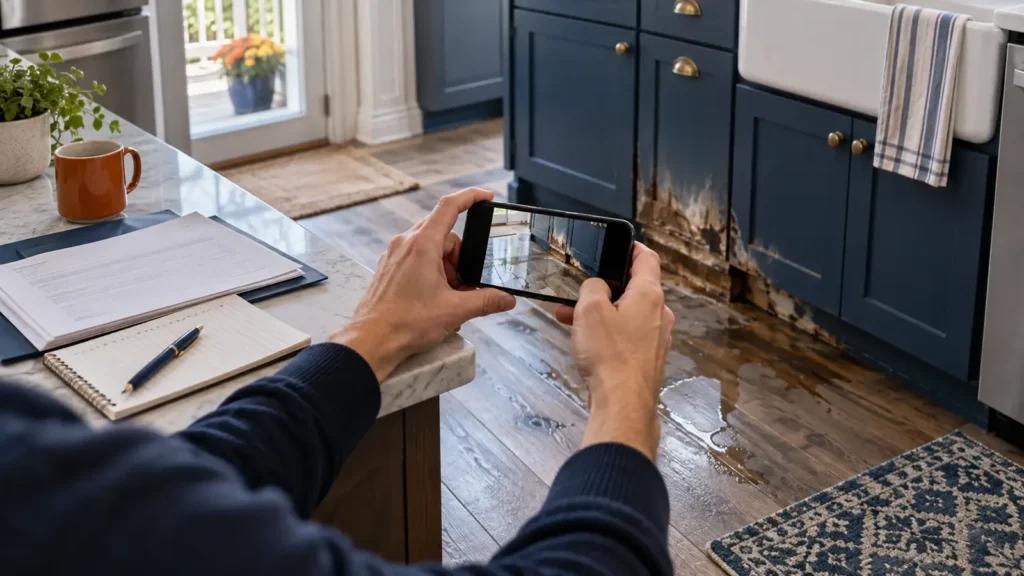
- Document before you clean. Photos and video of every wet room, the broken pipe and damaged belongings. See documenting water damage for insurance.
- Report the claim promptly by phone or app, and write down the claim number and adjuster's name.
- Start drying. Waiting for the adjuster is not a reason to let water sit. Mold can start within 24 to 48 hours. See removing flooring before the adjuster comes.
- Keep the broken pipe and any removed materials until the adjuster says you can discard them, or photograph them well.
- Keep every receipt for repairs, equipment, hotel stays and meals.
See water damage insurance claim help in Chicopee.
Should you file at all?
If the damage is close to your deductible, a claim may not be worth it. Get a written estimate first, then decide. See should I file a water damage claim.
Who you can hire
You can usually choose your own water mitigation company. Your insurer may suggest one, but you are not normally required to use it. See choosing your own mitigation company.
The insurer's adjuster works for the insurance company. A public adjuster works for you and, in Massachusetts, must hold a state license. Only a licensed public adjuster or an attorney can negotiate the claim on your behalf. A restoration company can document the damage and send its records to your adjuster, but cannot negotiate for you. See public adjuster vs insurance adjuster.
If your claim is denied
- Ask for the denial in writing, with the exact policy language it relies on.
- Compare that language to what actually happened.
- Send any evidence the insurer did not have: photos, readings, repair invoices, weather records.
- Ask for a review.
- If you still disagree, contact the Massachusetts Division of Insurance Consumer Services Unit at 617-521-7794, or talk to a licensed public adjuster or attorney.
See water damage claim denied in Massachusetts.
Renters, condo owners and landlords
- Renters: renters insurance covers your belongings and extra living costs, not the building. See does renters insurance cover burst pipes
- Condo owners: an HO-6 policy covers your unit's interior and belongings, while the association's master policy covers common parts. See HO-6 condo policy and water damage
- Landlords: the building policy covers the structure. In a two- or three-decker, one burst can mean claims on several policies. See upstairs water damage: who pays and rentals and condos: who pays
How we help with your claim
Water Damage Pro fixes the pipe and dries the house in one call. We photograph the damage, record moisture readings every visit, keep the removed materials or photos of them, and send that documentation to your adjuster. That record is what most claims depend on.
Policy terms that decide your claim
Replacement cost or actual cash value
A replacement cost policy pays what it costs to repair or replace damaged property with new material of like kind and quality. An actual cash value policy subtracts depreciation for age and wear. Many replacement cost policies pay the actual cash value first and hold back the depreciation until the repairs are done and you send proof. That is why the first check can look low. Ask your adjuster how much was held back and what you need to send to recover it.
Flat or percentage deductible
Most Massachusetts homeowners policies use a flat deductible, such as $1,000. Some have a separate, higher deductible for certain losses, or a percentage of the dwelling coverage. Check your declarations page before you file so you know what you will pay.
Additional living expenses
If your home cannot be lived in during drying and repairs, the loss of use part of your policy usually pays reasonable extra costs above your normal living expenses: a hotel or rental, extra meals, sometimes laundry and mileage. Keep every receipt and ask your adjuster about limits before you book.
Mold limits
Many policies cap mold coverage at a set dollar amount, even when the mold came from a covered burst pipe. Fast drying keeps mold from becoming a separate, limited part of your claim.
Common reasons claims run into trouble
- Late notice: waiting days or weeks to report the damage
- No photos from before cleanup: the adjuster cannot see what was there
- Repeated or long-term leakage: stains, rot or mold that show the leak went on for a long time
- Heat not maintained: a cold, empty house when pipes froze
- Not preventing further damage: leaving water to sit while waiting for the adjuster
- Thrown-out evidence: the broken pipe and damaged materials gone before anyone saw them
Every one of these can be avoided in the first day: stop the water, photograph everything, report the claim, keep the broken pipe, and start drying.
Your rights in Massachusetts
Massachusetts law requires insurers to handle claims fairly and promptly and to explain the reasons for a denial. If you think your claim is being handled unfairly, put your concerns in writing to the insurer first. If that does not resolve it, the Massachusetts Division of Insurance Consumer Services Unit takes consumer complaints at 617-521-7794. A licensed public adjuster or an attorney can represent you in a dispute. This is general information, not legal advice.
Questions to ask your agent before winter
- Does my policy cover freezing damage, and what do I have to do to keep that coverage if I am away?
- Is there a vacancy clause, and after how many days does it apply?
- Do I have water or sewer backup coverage, and what is the limit?
- What is my deductible, and is it different for water losses?
- Is my dwelling covered at replacement cost?
- How much mold coverage do I have?
- Is there a discount for a leak sensor or automatic shut-off valve?
Write the answers down and keep them with your policy. A five-minute call in October can save a denied claim in February.
Questions
Does my deductible apply to a burst pipe?
Yes. Your deductible is subtracted from what the insurer pays. Some policies have a separate water deductible.
Will a claim raise my premium?
It can, depending on your insurer and claim history. Ask your agent before filing a small claim.
How long do I have to report the damage?
Policies require prompt notice. Report it as soon as the water is stopped.
Can the insurer recover costs from someone else?
Yes. If someone else caused the damage, your insurer may pay you and then pursue them, which is called subrogation.
Burst pipe now? Call
Call (413) 603-1274 now. Pipe repair, drying and claim documentation, locally owned in Chicopee.