Mold is a moisture problem first. Call (413) 603-1274. We find the water feeding it, fix the leak, remove the moldy materials and dry the area so it does not grow back.
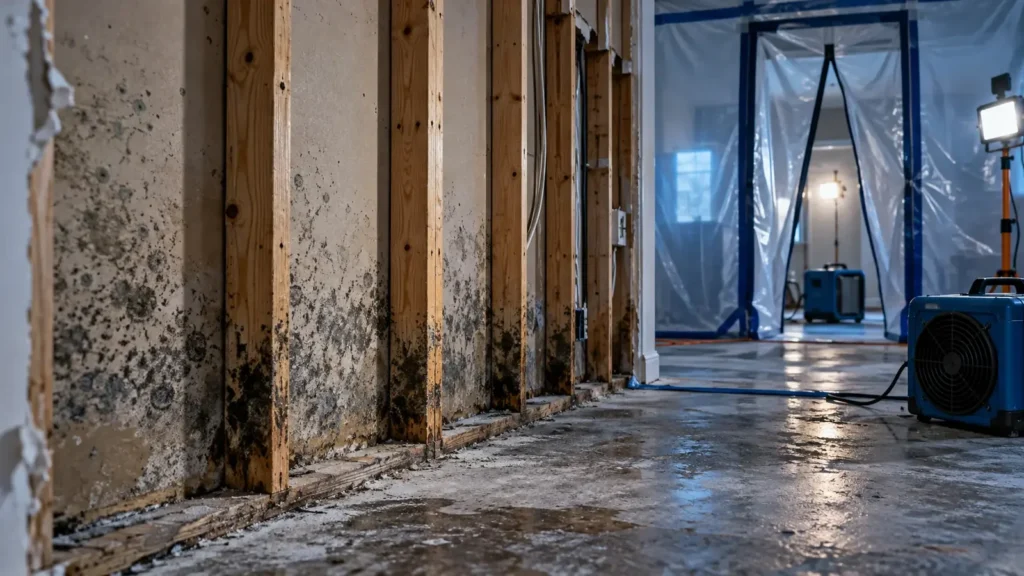
Why mold follows water damage
Mold needs moisture and something to eat, and houses are full of food for it: drywall paper, wood, carpet backing, dust. When materials stay wet for more than a day or two, mold can start growing, usually out of sight on the back of drywall, under flooring or inside a wall cavity. The U.S. Environmental Protection Agency advises drying wet materials within 24 to 48 hours to prevent it.
Signs of mold after a leak
- A musty, earthy smell that is stronger in one room or near one wall
- Black, green or white spotting on walls, ceilings or baseboards
- Stains that keep coming back after painting
- Peeling or bubbling paint near an old leak
- Allergy or breathing symptoms that ease when you leave the house
Mold can trigger allergies and asthma and can be more serious for people with weak immune systems. If someone in the home is having symptoms, talk to a doctor. Keep people with breathing problems away from the area while it is opened up and cleaned.
How we handle mold after water damage
- Find the moisture. Moisture readings and inspection show where the water is and how far the growth may go.
- Fix the leak. Without that, any cleanup is temporary.
- Contain the area. Plastic barriers and air filtration keep spores from spreading to clean rooms while work is done.
- Remove what cannot be cleaned. Moldy drywall, insulation, carpet pad and other porous materials are cut out and bagged.
- Clean what can stay. Framing and hard surfaces are cleaned.
- Dry everything. Dehumidifiers and air movers until readings are normal.
- Repair. Once dry and clean, walls and floors are rebuilt.
Mold in Chicopee homes
Chicopee's older housing stock gives mold plenty of chances: fieldstone and block basements that stay damp, plaster walls that hold water out of sight after a pipe bursts, and slow leaks in two- and three-decker bathrooms that soak into the floors below for months. Winter bursts often turn into mold problems in spring, when the house warms up and the hidden water starts to smell.
Testing
When mold is visible and the cause is known, testing often adds cost without changing the fix. Testing can help when you smell mold but cannot find it, or after cleanup to confirm the area is back to normal. Read how to check for mold after a leak and mold remediation rules in Massachusetts.
Small patch or bigger job?
The U.S. Environmental Protection Agency suggests that a homeowner can usually clean a small area of mold, roughly up to about 10 square feet, on hard surfaces, as long as the moisture problem is fixed. Larger areas, mold inside walls, ceilings or HVAC, mold after sewage or dirty water, or anyone in the home with asthma or a weak immune system are reasons to have it handled with containment.
| Usually fine to clean yourself | Usually needs a pro |
|---|---|
| Spots on tile, a window sill or a sealed surface | Patches larger than a few square feet |
| The leak is fixed and the area is dry | Mold behind walls or under floors |
| No one in the home has breathing problems | After sewage or a long-hidden leak |
What containment means
Containment keeps spores from spreading to the rest of the house while moldy material comes out. It usually means plastic sheeting sealed around the work area, a zipper door, and an air filtration machine that pulls air out of the space through a fine filter so the contained area is under slight negative pressure. Moldy drywall and insulation are bagged inside the containment before they are carried out. Afterward, surfaces are cleaned, the area is dried and checked, and only then is it rebuilt.
Painting over it does not work
Paint, bleach on drywall and "mold-killing" sprays may hide the color for a while, but mold growing into a porous material like drywall paper comes back if the material stays damp. Bleach also does not remove the dead mold, which can still cause allergy symptoms. On porous materials the fix is removal and replacement, and on hard surfaces it is cleaning with detergent and water, followed by thorough drying. See how to check for mold after a leak and Massachusetts mold rules.
Mold questions
Can I clean mold with bleach?
On a small spot on a hard surface, a household cleaner can work. Bleach does not fix mold inside drywall or wood, and the moisture source still has to be fixed.
Is black mold dangerous?
Any mold indoors should be removed, whatever the color. See is black mold from a burst pipe dangerous.
Does insurance cover mold?
Many policies cover mold only when it comes from a covered sudden leak, often with a limit. Mold from a long-term leak is often excluded. Check your policy.
Musty smell or mold? Call now
Call (413) 603-1274 now. Locally owned in Chicopee. See areas we serve.