Pipes in Chicopee freeze most often in January and February, in homes built before 1960 with pipes in outside walls, porches, crawl spaces and drafty basement sills. If a pipe is frozen, open the faucet, warm the pipe gently with a hair dryer or space heater (never an open flame), and shut off the main water valve if you see bulging or a split. If it has already burst, shut the water off and call (413) 603-1274 for the pipe repair and the drying in one visit.
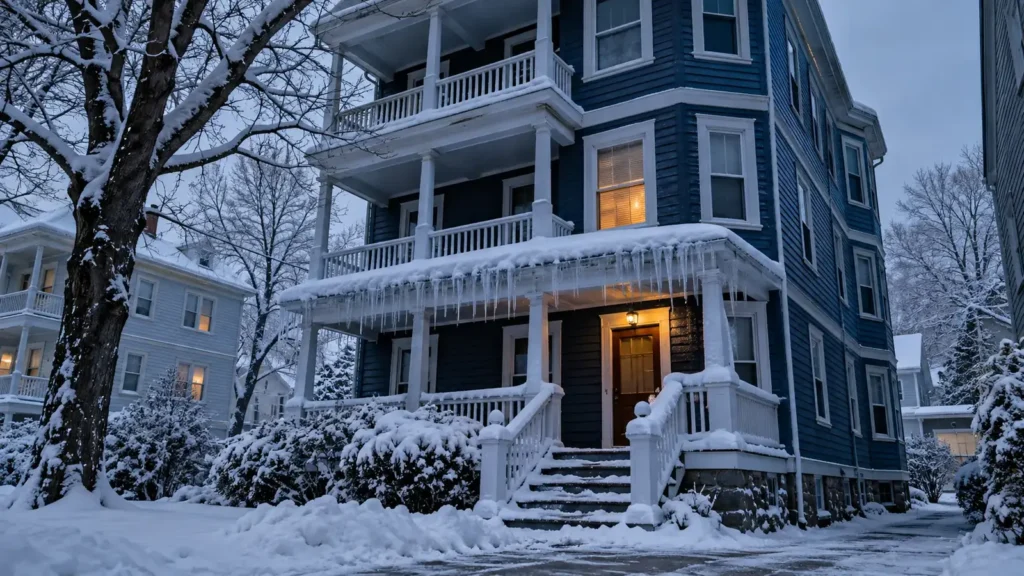
How often Chicopee pipes are at risk
Over the 30 winters from 1997 to 2026, Chicopee averaged about 130 nights at or below freezing and about 50 nights at or below 20°F, the range where unprotected pipes in cold spots start to freeze. There were about 18 nights a winter at or below 10°F and about 5 below zero. Winter 2026 was the coldest in about seven years, with 7 nights below zero and a reading of 15 below at Westover Field on January 31.
| Measure | 30-winter average |
|---|---|
| Nights at or below 32°F | 130 |
| Nights at or below 20°F | 50 |
| Nights at or below 10°F | 17.6 |
| Nights at or below 0°F | 4.8 |
Full numbers, year by year, are in the Chicopee freeze report.
Why Chicopee homes freeze
About half of Chicopee homes were built before 1960, and many of the two- and three-deckers in Willimansett, Chicopee Center and Chicopee Falls are older than that. Those houses were plumbed before modern insulation, so pipes often run where cold air reaches them.
- Outside walls, especially kitchen sinks on a north or west wall
- Porches and back stairs that were closed in later, with pipes in the old exterior wall
- Basement sills and rim joists, where wind gets in at the top of the foundation
- Crawl spaces and additions built on piers or slabs with little insulation
- Outdoor faucets left connected to a hose
- Vacant units between tenants, with the heat turned down
Pipes can freeze even with the heat on, when a pipe sits in a cold pocket of an outside wall. See can pipes freeze with the heat on.
What temperature pipes freeze at
Water freezes at 32°F, but a pipe inside a house usually needs the outdoor temperature to fall much lower, often into the low 20s or teens for several hours, before the water in a cold spot freezes. Wind makes it worse because it pulls heat out of walls faster. See what temperature pipes freeze at and how long before a frozen pipe bursts.
Hot water lines freeze too, sometimes sooner than cold lines, because the water in them sits still for longer between uses. See do hot water pipes freeze.
Signs a pipe is frozen
- A faucet that gives a trickle or nothing on a cold morning
- Frost on a pipe you can see
- A toilet that will not refill
- A strange smell from a drain, as air is pushed back
- Bulging or a crack in a visible pipe
If you see a crack or bulge, shut off the main water valve before you start thawing. See how to shut off your main water valve.
How to thaw a frozen pipe safely
- Open the faucet the pipe feeds, hot and cold, so melting water has somewhere to go.
- Find the frozen spot. Start near the faucet and work back toward where the pipe enters the cold area.
- Warm it gently with a hair dryer, a heating pad, warm towels or a space heater kept away from anything that burns.
- Never use a torch or open flame. Old framing and dry lath catch fire easily.
- Keep the heat on until full flow returns, then check the pipe for leaks.
Full steps are in how to thaw frozen pipes. If the pipe is inside a wall or you cannot find the frozen spot, see frozen pipe thawing in Chicopee.
Will it thaw on its own?
Often it will when the weather warms, but that is also when frozen pipes split open and flood. Waiting means you may not be home when it lets go. See will frozen pipes thaw on their own.
Why pipes burst when they thaw
Ice in a pipe traps water between the ice and a closed faucet. As more water freezes, pressure in that trapped section climbs until the pipe splits. You often do not see the split until the ice melts and water runs through it. That is why burst pipe calls in Chicopee spike one to three days after a cold spell breaks. Over 30 winters, we counted 64 times when a night at or below 5°F was followed within three days by a day of 45°F or warmer. See why pipes burst when they thaw.
If a frozen pipe bursts
- Shut off the main water valve. If it will not turn, see main valve won't shut off.
- Turn off power to any wet area at the breaker, if you can reach it safely.
- Open faucets to drain the lines.
- Take photos and video before you move anything.
- Call for the repair and the drying. See what to do when a pipe bursts.
Water Damage Pro fixes the pipe and dries the house in one call, so you are not waiting on a second company while water soaks into plaster and floors.
Preventing frozen pipes
Before the cold
- Insulate pipes in basements, crawl spaces and closed-in porches. See pipe freeze protection
- Seal drafts at the sill plate and around pipe holes in outside walls
- Disconnect hoses and shut off and drain outdoor faucets. See keeping outdoor faucets from freezing
- Know where your main shut-off is, and replace a stuck gate valve. See gate valve vs ball valve
- Book oil deliveries early, or set up automatic delivery
During a cold snap
- Keep the heat steady day and night
- Open sink cabinet doors on outside walls
- Let at-risk faucets drip. See should you drip faucets
- Check the coldest rooms and the basement morning and night
When you are away
Keep the thermostat no lower than 55°F, have someone check the house, and consider shutting off and draining the water if you will be gone long. See house temperature when away in winter and winterizing a vacant house. Automatic shut-off valves and leak sensors add a layer of protection. See do automatic shut-off valves work.
When the heat goes out
Many Chicopee homes still heat with oil. If the tank runs dry or the boiler quits in a cold snap, the clock starts on your pipes. A well-sealed house may hold above freezing for many hours, but a drafty older home in single digits can freeze pipes much faster. See ran out of oil and pipes froze and how long before pipes freeze without heat.
Hot water baseboard and radiator pipes can freeze and split too, often in an outside wall or under a floor. See heating pipe burst repair.
Landlords and tenants
In Massachusetts, landlords must supply heat that keeps habitable rooms at least 68°F by day and 64°F at night from September 15 to May 31 under the State Sanitary Code. A pipe that freezes because the building was not heated is usually the landlord's to fix. See water damage in Massachusetts rentals.
Does insurance cover frozen pipes?
Most Massachusetts homeowners policies cover sudden water damage from a pipe that bursts after freezing, as long as you took reasonable care to keep the house heated. Vacant homes and unheated buildings are a common exception. See burst pipe insurance in Massachusetts.
The worst freezes in recent Chicopee history
- January 2003: 17 days in a row without the temperature rising above freezing
- January 2005: 15 days below freezing
- February 2015: 11 days below freezing with lows of 13 below. The Chicopee Water Department took over 100 frozen pipe calls in two weeks
- Late December 2017 into January 2018: 14 days below freezing with a low of 12 below
- February 2023: 9 below, then 48°F two days later, a classic burst pipe pattern
- Late January 2026: 9 days below freezing, with Westover Field reading 15 below on January 31
Long cold stretches like these are when pipes that have been fine for years finally freeze. See the Chicopee freeze report.
Questions
What is the coldest time for pipes in Chicopee?
January, then February. Nights below zero happen almost only in those two months.
Can I use a space heater to thaw a pipe?
Yes, if it is kept away from anything that can burn and never left alone. Never use an open flame.
How do I stop the same pipe freezing again?
Insulate it, seal the draft that reaches it, and in some cases move it to a warmer wall. See repiping.
Should I call a plumber for a frozen pipe?
If you cannot find or reach the frozen spot, or you see a crack, yes. A frozen pipe inside a wall needs a professional.
Frozen or burst pipe? Call now
Call (413) 603-1274. Locally owned in Chicopee. Pipe repair and drying in one call.